What are central bank digital currencies actually for?
An open-source research project documenting the purpose, development stage and privacy design of central bank digital currencies from the official record. The current v10.2e release uses two independent language-model extractions, exact source-span verification, an explicit ensemble rule and a completed blind human audit; consensus adjudication remains work in progress.
The state of CBDCs around the world
DEVELOPMENT STAGE, DOCUMENTED PURPOSE AND PRIVACY POSTURE FROM THE CURRENT FROZEN CORPUS.
Every coloured jurisdiction is linked to the newest official stage evidence in the corpus. Hover to preview and click to pin the country panel. The panel also shows the ensemble purpose classification, exploratory privacy posture and the documents used in the extraction. Source PDFs are identified but not redistributed; the reproducibility manifest records filenames, page counts and hashes.
Hover over a country
Why this dataset
STATUS TRACKERS SAY HOW FAR A PROJECT HAS MOVED. THEY DO NOT SAY WHAT IT IS FOR.
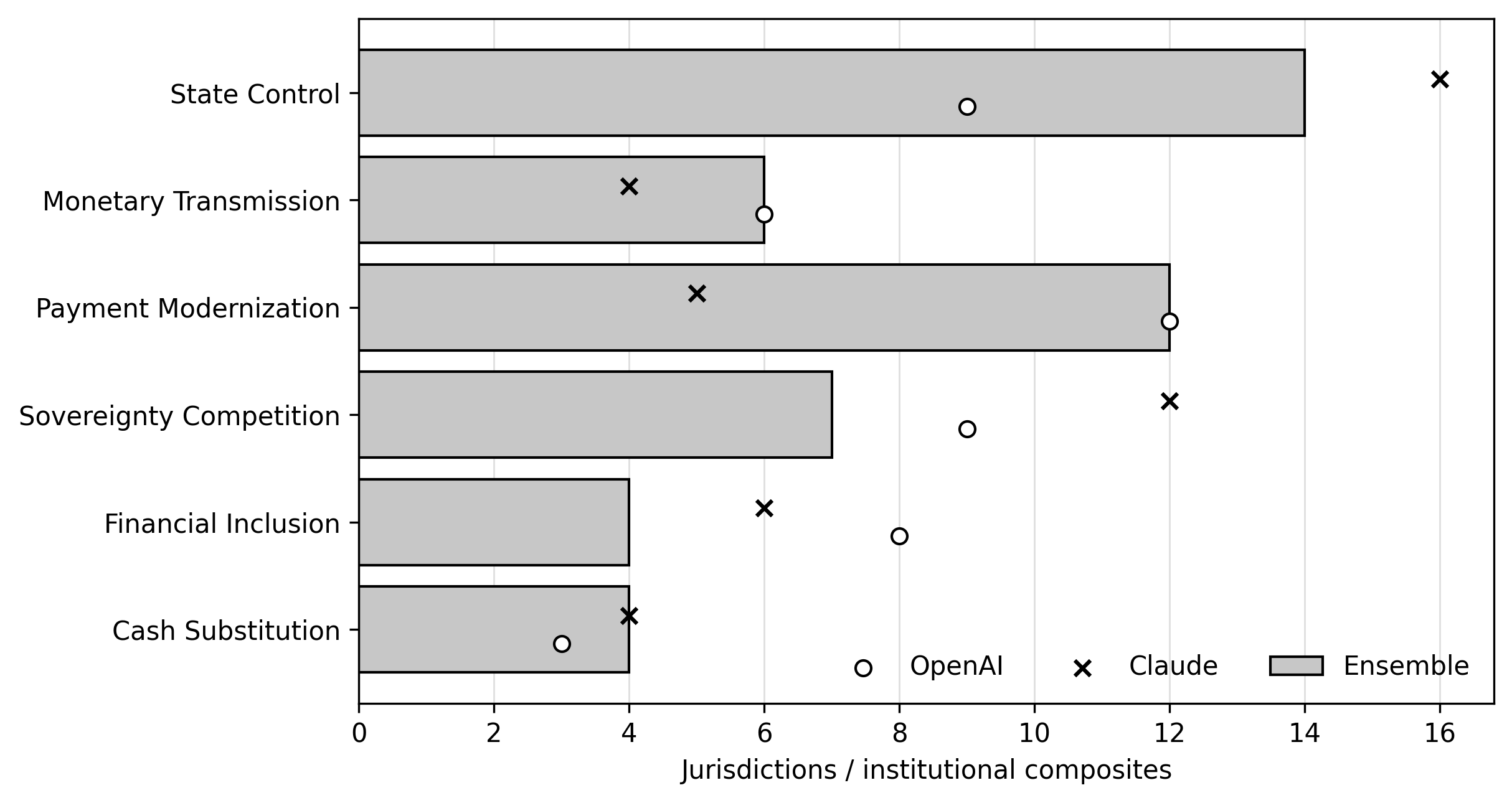
The same “pilot” label can cover projects aimed at payment modernisation, monetary sovereignty, financial inclusion or tighter state control. We therefore measure six purpose centres and keep privacy vocabulary separate from documented design posture. The corpus contains 113 documents and 3,963 page units; OpenAI and Claude produced 11,358 source-verified statements, deduplicated into 6,949 analytical candidates.
Four findings
CURRENT EXPLORATORY RESULTS — BLIND AUDIT COMPLETE, CONSENSUS ADJUDICATION OPEN.
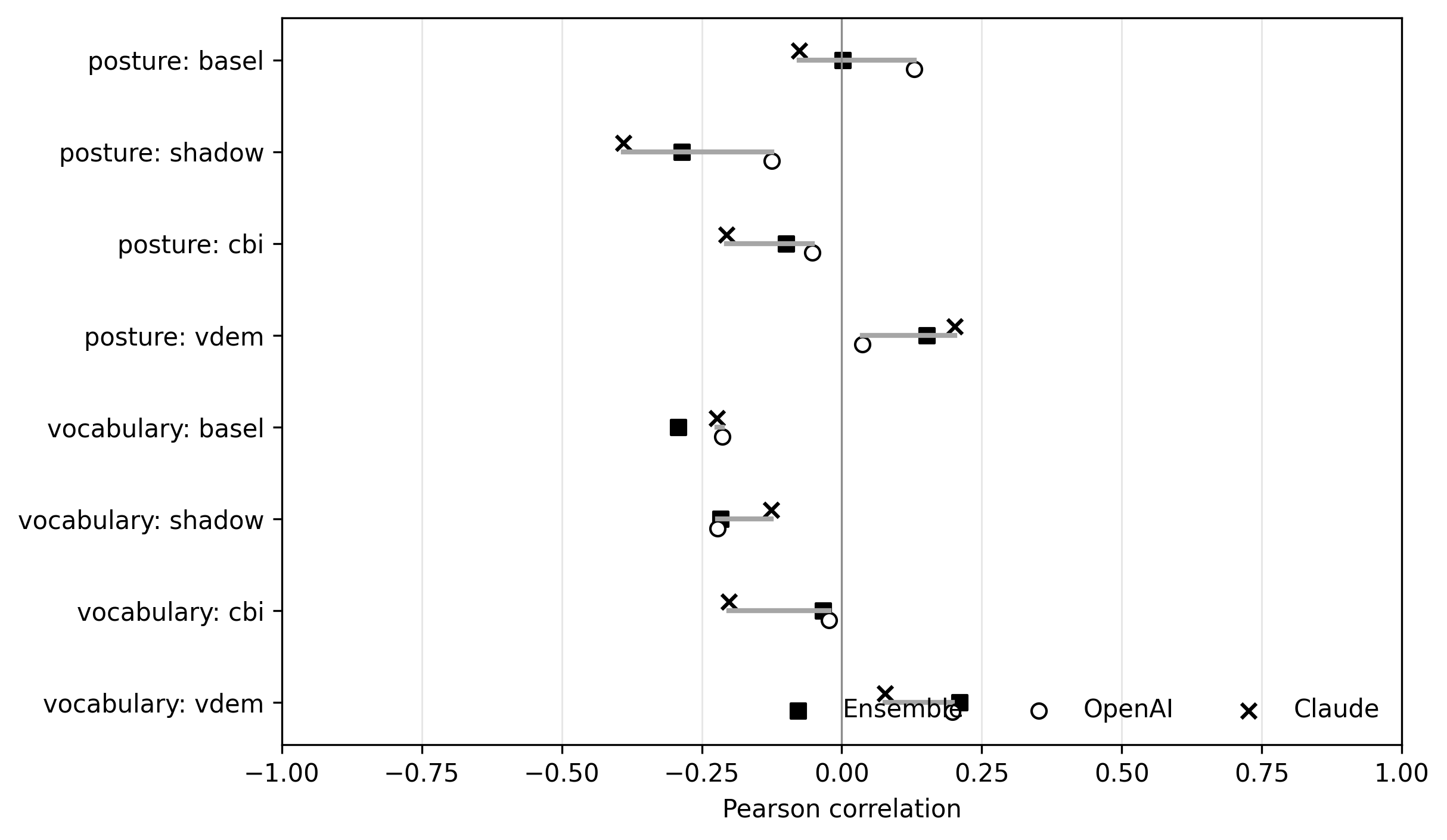
Privacy language is not privacy commitment. Privacy-family frequency and documented posture correlate only r = 0.219 (95% CI [−0.102, 0.525], n = 39), about 4.8% shared variance.
No tested institutional condition survives multiplicity correction. The largest posture-side association is with informal-economy size (r = −0.286, 95% CI [−0.532, 0.007], Holm-adjusted p = 0.651). It is a lead for further research, not a confirmed effect.
Model choice changes the descriptive picture. Exact code-set agreement is 41.5% among candidates found by both providers, and 38.0% of union candidates come from only one provider. The paper therefore reports an equal-vote ensemble and provider-specific sensitivity.
Aggregate validity is similar, item-level agreement is limited. Reviewer-specific design-weighted validity is 78.6% and 76.1%, while inclusion agreement is 62.6% (Gwet’s AC1 = 0.426). The 77.3% midpoint is descriptive, not a final consensus estimate.
Privacy posture explorer
Compare each entity’s documented privacy posture with how much of its coded material belongs to the privacy family. The values are derived from the current v10.2e ensemble and remain exploratory because calibrated recall missed its frozen threshold and the completed blind audit has not yet been consensus-adjudicated.
See the six purpose centres
Provider sensitivity remains visible
Open by design
The repository exposes the frozen canonical provider outputs, provenance manifests, exact-span checks, ensemble rule, analysis scripts, completed paired human decisions and derived outputs. The independent blind phase covered 365 candidates and 36 dual-empty source units; all released pre-adjudication metrics can be regenerated from the public case-level files.
Work in progress
v10.2e is a transparent research release, not a finished measurement standard. We are testing whether improving LLMs, a larger and better-balanced sample of official documents, and a more precisely operationalized family structure can improve recall, cross-provider stability and human coding agreement in future research.